


Medically and stylistically reviewed content is not required here, but every claim in this guide is based on established color theory principles used by professional color analysts and image consultants.
Quick answer: A season color palette is a set of colors — grouped into Spring, Summer, Autumn, or Winter — that’s matched to your natural skin undertone, hair color, and eye color. Finding your helps you choose clothing, makeup, and accessories that make your skin look clearer, your eyes look brighter, and your overall coloring look balanced, without guesswork.
What Is a Season Color Palette?
A season color palette is a curated group of colors — organized under one of four “seasons” (Spring, Summer, Autumn, Winter) — that complements a person’s natural coloring. The idea comes from seasonal color analysis, a method that groups colors by three properties: temperature (warm or cool), depth (light or deep), and clarity (bright or muted). Your natural coloring — skin undertone, hair color, and eye color — tends to align more with one of these groupings than the others.
The reason this matters practically: colors that match your natural temperature and depth tend to make your skin look healthier and more even, while colors that clash with it can make you look tired, sallow, or washed out — even if the color itself is “in style.”
This isn’t a trend invented for social media. color theory has roots in 1980s image consulting (most notably the book Color Me Beautiful by Carole Jackson), and it’s built on color-wheel principles that go back much further. What’s changed recently is accessibility — DIY quizzes, AI-based apps, and short-form video have made it something people can explore themselves instead of only through a paid consultation.
The 4 Color Seasons, Explained
Each season represents a different combination of undertone, depth, and clarity. Here’s how they break down at a glance:
| Season | Undertone | Depth | Clarity | Best Known For |
|---|---|---|---|---|
| Spring | Warm | Light to medium | Clear, bright | Fresh, vivid colors like coral, golden yellow, warm green |
| Summer | Cool | Light to medium | Soft, muted | Gentle colors like powder blue, dusty rose, lavender |
| Autumn | Warm | Medium to deep | Muted, rich | Earthy colors like rust, olive, mustard, terracotta |
| Winter | Cool | Medium to deep | Clear, bold | High-contrast colors like true red, emerald, black, icy blue |
Spring
Spring coloring is typically warm, light, and clear. People in this season often have golden or peachy undertones, hair ranging from strawberry blonde to light golden brown, and eyes that are light and bright (clear blue, green, or light hazel). The palette leans toward fresh, saturated warm colors — think coral, warm turquoise, golden yellow, and grass green. Muted or overly dark colors (like charcoal or dusty mauve) tend to overwhelm this coloring.
Summer
Summer coloring is cool, light to medium, and soft. Undertones are pink or rosy, hair is often ash blonde to soft brown, and eyes tend to be soft blue, grey, or muted green. The palette favors gentle, cool colors with a slightly greyed-down quality — powder blue, soft lavender, dusty rose, and sage. Bright, high-saturation colors can look harsh against this coloring.
Autumn
Autumn coloring is warm, medium to deep, and muted. Undertones lean golden or olive, hair ranges from auburn to deep golden brown, and eyes are often warm brown, hazel, or olive-green. The palette centers on rich, earthy tones — rust, mustard, olive, camel, and terracotta. Cool, icy colors tend to fight against this coloring rather than complement it.
Winter
Winter coloring is cool, medium to deep, and clear. Undertones are blue-based, hair ranges from dark brown to black (or platinum), and eyes are often dark brown, deep blue, or grey with strong contrast against the skin. The palette leans toward bold, high-clarity colors — true red, emerald, sapphire, and pure white or black. Muted, dusty colors can make this coloring look flat.
Going Beyond the Basic 4: The 12 and 16 Season Systems
If you’ve researched this recently, you’ve probably seen references to “Soft Autumn,” “True Winter,” “Bright Spring,” or “Deep Summer.” These come from more detailed color analysis systems that split each of the four base seasons into two to four sub-seasons.
Here’s why the sub-seasons exist: not everyone fits neatly into one of four boxes. Someone can have Autumn’s warmth but Winter’s depth — which is where a sub-season like Deep Autumn comes in. The 12-season system adds one sub-season overlap between each neighboring pair (for example, Warm Spring sits between Spring and Autumn). The 16-season system goes further, giving each of the four base seasons four distinct variations.
For most people, starting with the 4-season system is enough to shop smarter. But if your results feel like they’re “half warm, half cool” or “too soft for bright Winter but too bold for Summer,” a 12- or 16-season breakdown is usually what resolves that.
How to Find Your Season Color Palette (Step-by-Step)
You don’t need a professional consultation to get a reasonably accurate starting point. Here’s how color analysts approach it, broken into steps you can do at home with natural light and a mirror.
Step 1: Determine Your Undertone
Undertone is the single biggest factor in seasonal color analysis. Check the veins on your inner wrist in natural daylight:
- Blue or purple veins usually indicate a cool undertone (Summer or Winter).
- Green veins usually indicate a warm undertone (Spring or Autumn).
- A mix of blue and green often indicates a neutral undertone, which means depth and clarity (Steps 3–4) will matter more than temperature.
A second check: hold silver and gold jewelry against your skin. Cool undertones typically look better in silver; warm undertones typically look better in gold.
Step 2: Take Note of Your Hair Color
Natural hair color (not dyed) gives another data point. Ashy, cool-toned hair colors (platinum blonde, ash brown, blue-black) point toward Summer or Winter. Golden, warm-toned hair colors (strawberry blonde, auburn, golden brown) point toward Spring or Autumn.
Step 3: Analyze Your Eye Color
Eye color contributes to both temperature and clarity. Clear, bright eye colors (bright blue, clear green) suggest Spring or Winter. Softer, more muted eye colors (grey-blue, hazel, soft brown) suggest Summer or Autumn.
Step 4: Understand Your Contrast Level
Contrast is the difference between your skin, hair, and eye color. High contrast (dark hair, light skin, or vice versa) generally points toward Winter. Low contrast (similar tones across skin, hair, and eyes) generally points toward Summer. Spring and Autumn typically fall in the middle, distinguished mainly by warmth.
Step 5: Put It All Together
Cross-reference your undertone (Step 1) with your depth and contrast (Steps 2–4):
- Warm + light + clear → Spring
- Cool + light + soft → Summer
- Warm + deep + muted → Autumn
- Cool + deep + clear → Winter
If two seasons seem to fit, that’s normal — it likely means you fall into one of the sub-seasons covered above, and a more detailed quiz or professional draping session (where fabrics are held up against your face to compare) can confirm it.
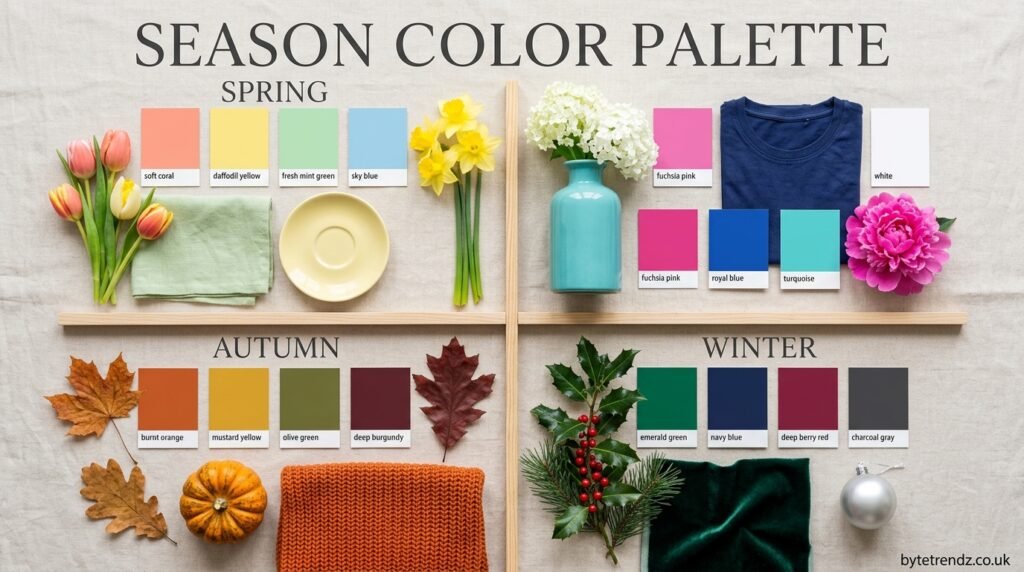
Season Color Palette Cheat Sheet
For quick reference, here are the go-to colors for each season:
- Spring: coral, peach, warm turquoise, golden yellow, grass green, ivory
- Summer: powder blue, dusty rose, lavender, soft grey, sage, mauve
- Autumn: rust, mustard, olive, camel, terracotta, deep teal
- Winter: true red, emerald, sapphire, black, icy pink, pure white
Save or screenshot this section as a shopping reference — it’s the fastest way to sense-check an item before you buy it.
How to Use Your Season Color Palette in Real Life
Knowing your season only helps if you apply it. Here’s how to put it to use across the areas people usually ask about:
Clothing & wardrobe: Anchor your everyday basics (tops, outerwear, bags) in your season’s neutrals, and use your season’s brighter shades for accent pieces — scarves, blouses, or accessories — rather than trying to overhaul your whole closet at once.
Makeup: Foundation should match your undertone above all else. From there, lean into your season for blush, lipstick, and eyeshadow — generally suit peach and terracotta tones, while cool seasons generally suit rose and berry tones.
Hair color: If you dye your hair, staying within your season’s warmth level (rather than your exact natural color) usually looks more cohesive than switching temperature entirely — for example, a Winter going platinum will typically look more balanced than a Winter going golden blonde.
Accessories: Metal tone matters here too — gold for warm , silver for cool seasons, and either works for some neutral-leaning individuals.
Common Mistakes When Choosing Your Season
Even with a clear process, there are a few places people go wrong:
- Judging color under artificial light. Indoor lighting, especially warm bulbs, distorts undertone. Always check in natural daylight.
- Assuming skin color equals undertone. Deep skin and fair skin both come in warm, cool, and neutral undertones — depth and undertone are two separate things.
- Ignoring exceptions. Some colors, like a true red, sit close to the center of the color wheel and flatter nearly everyone regardless of season — don’t rule out a color just because it’s not “officially” on your list.
- Treating your season as permanent and rigid. Sun exposure, aging, and hair color changes can shift how a palette looks on you over time. l color analysis is a helpful guide, not a strict rulebook.
Frequently Asked Questions
What if I have features of two seasons? This is common and usually means you fall into a (like Warm Spring or Deep Autumn) that blends traits from two neighboring seasons. A 12- or 16-season quiz, or a professional draping session, can pinpoint it more precisely.
Can a professional color analysis be wrong? It can be, especially if it’s done under poor lighting or by an inexperienced analyst. Even professional results can vary slightly between analysts, since some borderline cases genuinely sit between two seasons.
Is a DIY color analysis quiz accurate? A well-built quiz that asks about undertone, hair, eye color, and contrast can get you very close — often close enough to shop confidently. It may be less precise than in-person draping for people who fall into s overlaps.
How much does professional color analysis cost? In-person sessions with a certified color analyst typically range from roughly $150–$500 depending on location and consultant experience, while online or app-based versions are generally much less expensive.
Do color seasons change over time? Your underlying undertone stays the same throughout life, but depth and contrast can shift slightly with sun exposure, greying hair, or aging skin — which is why some people find their best colors evolve gradually over the years.
Final Takeaway
Your season color palette isn’t about restricting what you wear — it’s a shortcut for choosing colors that work with your natural coloring instead of against it. Start with the undertone check, cross-reference it with your hair and eye color, and use the cheat sheet above the next time you’re shopping. If your results feel like they’re between two seasons, that’s a strong sign a 12- or 16-season breakdown — or a quick quiz — will get you a more precise answer.
