

Have you ever tried on two tops in almost the same shade and noticed that one made your skin glow while the other made you look tired? That reaction is not random. It comes down to how a color interacts with your natural undertone, and this is the exact idea behind a season color palette. Seasonal color analysis has been used by stylists, makeup artists, and everyday shoppers for decades to take the guesswork out of getting dressed, and it remains just as relevant today as color trends and personal style tools continue to evolve.
What Is a Season Color Palette
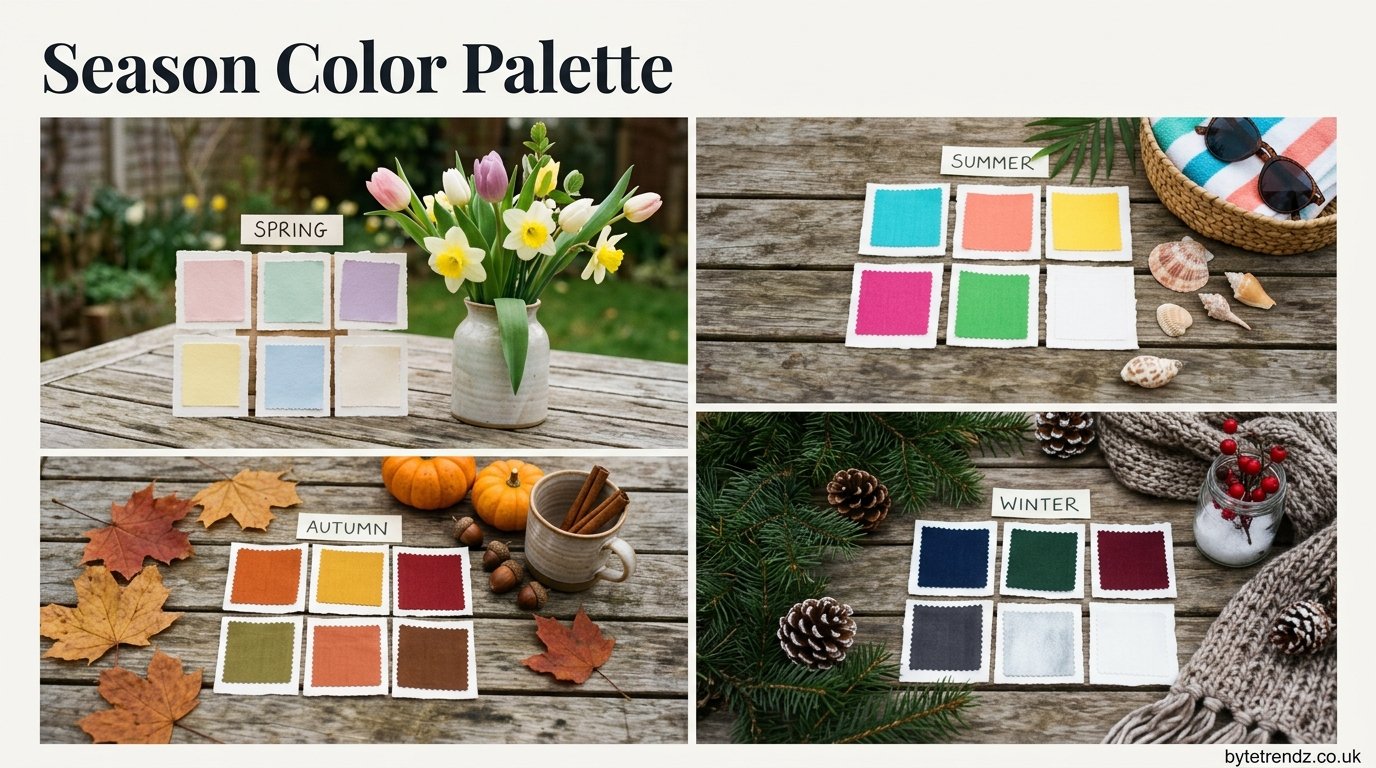
A season color palette is a curated group of colors that are believed to complement a person’s natural coloring, meaning their skin tone, hair color, and eye color working together. Instead of choosing clothes and makeup at random, seasonal color analysis groups people into categories inspired by the four seasons: Spring, Summer, Autumn, and Winter. Each of these seasonal groups shares a distinct combination of warmth, depth, and clarity that shows up consistently in a person’s coloring.
The idea traces back to early twentieth-century color theory, when artists and educators noticed that certain hues brought out more life in a portrait while others dulled it. This concept was later adapted into a beauty and fashion framework, and it gained mainstream popularity in the 1980s through a well-known color analysis book that introduced the four-season model to a wide audience. That original framework still forms the foundation that modern systems build on today.
Understanding your season color palette is not about limiting your wardrobe. It is about giving yourself a reliable starting point so that the colors you choose consistently work in your favor, whether you are picking out a blazer, a lipstick shade, or a hair color.
The Science Behind Seasonal Color Analysis
Seasonal color analysis is built on three core dimensions: undertone, value, and chroma. Undertone refers to whether your natural coloring leans warm, with golden or peachy hints, or cool, with pink or blue hints. Value describes how light or dark your overall coloring appears, while chroma measures how bright and saturated your coloring is compared to how soft and muted it looks.
These three qualities work together rather than separately. A person can have a warm undertone but still appear deep and muted, which places them in a very different category than someone who is warm, light, and bright. This is why simply knowing whether you are warm or cool is not enough to identify your full palette. Professional colorists often use a technique called draping, where different colored fabrics are held near the face under neutral lighting so the analyst can observe how each shade changes the appearance of the skin, under-eye area, and overall complexion.
This method is rooted in observable color science rather than personal opinion. The right shades tend to even out skin tone and reduce the appearance of shadows, while the wrong shades can make the skin look sallow, ashy, or fatigued. Because the effect is visible and repeatable, seasonal color analysis has remained a trusted tool across fashion and beauty industries for a long time.
The Four Main Seasons Explained
Spring is generally described as the warm and bright family. People in this category often have clear, fresh coloring that pairs beautifully with peach, coral, warm yellow, and grass green. Spring palettes tend to feel lively and sun-kissed rather than muted or heavy.
Summer sits on the cooler and softer end of the spectrum. This group usually suits blue-based shades with a gentle, blended quality, such as dusty rose, soft navy, lavender, and powder blue. Summer coloring often looks harmonious rather than sharply contrasted, which is why overly bright or overly warm colors can feel out of place on this palette.
Autumn leans warm but with more depth and earthiness compared to Spring. Rich colors like olive, rust, mustard, and warm brown tend to flatter this group because they echo the golden undertone naturally present in Autumn coloring. Winter, on the other hand, is defined by strong contrast and cool clarity, making bold jewel tones, true black, and icy brights particularly striking on this group.
Understanding the 12 Season Color System
While the four-season model is a helpful starting point, many people find that they do not fit neatly into just one of the four broad categories. This is where the 12-season system becomes useful. It takes each of the four parent seasons and divides it into three sub-seasons, creating twelve total categories that offer far more precision.
Spring and Autumn are typically refined using descriptors like True, Light, and Deep, while Summer and Winter are refined using terms such as True, Soft, and Cool. For example, a Light Spring leans toward fresh, warm pastels, while a Deep Autumn suits rich, earthy tones like burnt sienna and dark chocolate. This layered structure recognizes that two people can both be broadly “warm” while still needing very different palettes based on depth and brightness.
The twelve seasons are designed to flow into one another logically, moving gradually from the warm brightness of Spring through the cool softness of Summer and into the deeper, moodier tones of Autumn and Winter. This is part of why the 12-season approach is now considered the more accurate and widely used framework compared to relying on the four basic seasons alone.
How to Identify Your Own Color Season
Figuring out your season color palette does not always require a professional consultation, although that option can offer helpful precision. A simple starting point is examining the veins on your inner wrist in natural daylight. Veins that appear more green or olive typically suggest a warm undertone, pointing toward Spring or Autumn, while veins that look more blue or purple usually suggest a cool undertone, pointing toward Summer or Winter.
Another useful method is paying attention to how you look in metals and neutrals. Gold jewelry and warm-toned clothing often look more natural against warm undertones, while silver jewelry and cool-toned clothing tend to suit cooler undertones better. Comparing how your face looks next to a pure white top versus a warm ivory top can also reveal useful clues, since one will likely make your skin look brighter and healthier than the other.
It is completely normal to feel like you sit between two categories. The 12-season system exists partly to account for this, with in-between groups like Soft Summer and Soft Autumn built specifically for people whose coloring blends qualities from two neighboring seasons.
Applying Your Palette to Everyday Style
Once you have a general sense of your season, the easiest way to use it is as a filter rather than a strict rule. When shopping, check whether a piece falls within your palette family before buying it as a core wardrobe item. If a color falls outside your palette but you still love it, it can often work well as an accent piece, such as a bag or scarf, rather than a garment worn close to the face.
Over time, shopping this way naturally builds a wardrobe where more pieces coordinate with one another, which makes getting dressed noticeably easier. This also applies to makeup, where lipstick, blush, and eyeshadow shades chosen within your seasonal palette tend to look more natural and require less correction than shades chosen at random.
Hair color decisions can benefit from this approach too. Choosing a hair shade that aligns with your undertone, rather than fighting against it, tends to look more cohesive with your skin and eye color, creating a more polished and intentional appearance overall.
Common Misunderstandings About Color Seasons
One common misconception is that seasonal color analysis only works for certain skin tones or ethnicities. In reality, every skin tone can be categorized within this system because the analysis is based on undertone and contrast rather than how light or deep the skin itself is. A person with deep skin can be a Winter, an Autumn, or any other season depending on their specific undertone and contrast level.
Another misunderstanding is that your season changes with tanning, aging, or hair dye. Your underlying undertone generally stays consistent throughout life, even though surface factors like a suntan or gray hair may shift which specific shades within your palette look best at a given time. This distinction is important because it means you do not need to reassess your entire palette every time your appearance changes slightly.
Finally, some people assume that seasonal color analysis is only relevant for women or for fashion enthusiasts. In practice, this framework applies equally to men and works across all areas where color choices matter, including professional attire, eyewear, and even home and personal branding decisions.
Conclusion
A season color palette is a practical, well-researched tool that takes the uncertainty out of choosing colors that genuinely work for you. By understanding the roles of undertone, value, and chroma, and by exploring how the four main seasons expand into more precise sub-seasons, you can build a wardrobe and beauty routine that consistently makes you look healthier and more put together. Whether you rely on simple at-home clues or seek out a professional consultation, learning your season is a small investment that pays off every time you get dressed.
Frequently Asked Questions
What are the four main color seasons? The four main color seasons are Spring, Summer, Autumn, and Winter. Each one reflects a different combination of warmth, depth, and brightness found in natural skin, hair, and eye coloring.
How is the 12-season system different from the four-season system? The 12-season system divides each of the four main seasons into three sub-seasons, offering more precise palettes for people whose coloring does not fit neatly into just one broad category.
Can I determine my color season without professional help? Yes, simple methods like checking your wrist veins, comparing how you look in gold versus silver jewelry, and noticing your reaction to warm versus cool neutrals can offer a reliable starting point.
Does my color season change as I get older? Your underlying undertone typically remains stable throughout life, although surface changes like gray hair or a tan may slightly shift which specific shades within your palette look best.
Is seasonal color analysis suitable for all skin tones? Yes, this system works for every skin tone and ethnicity because it is based on undertone and contrast rather than how light or deep your skin appears.
